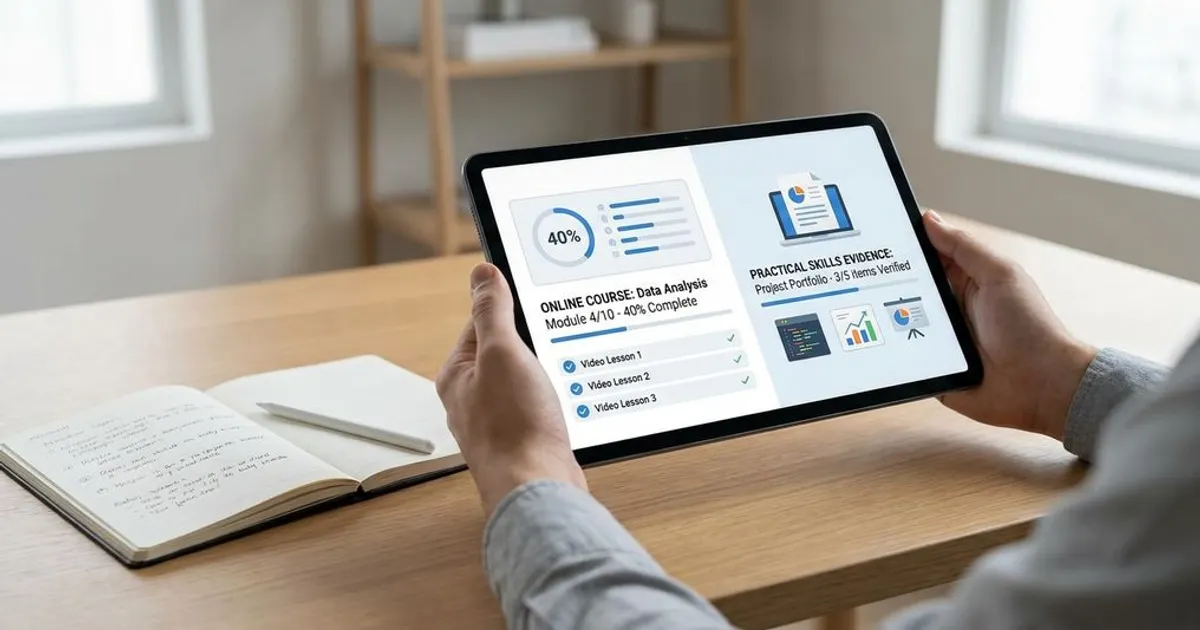
An online course is working for you when it changes what you can remember, explain, apply, and produce without constant prompting. A good online course assessment looks past watch time and asks one direct question: can you use the skill when the lesson is no longer open?
You can finish every video, pass easy quizzes, and still walk away with weak practical ability. This article helps you judge your real learning progress by checking retention, skill application, feedback, project quality, and course fit. By the end, you’ll know whether to continue, adjust your study method, supplement the course, or stop spending time on it.
How Do You Know If An Online Course Is Actually Working?
An online course is working when you can apply what you learned to a real task, explain the main ideas in your own words, and notice better performance over time. Completion alone is not enough; your output needs to improve.
Start by comparing your time spent with your ability gained. If you watched three hours of lessons on spreadsheets, coding, design, writing, finance, or project management, you should be able to complete a small task that uses those lessons. The task does not need to be perfect. It does need to show that you can move from recognition to action.
A useful test is simple: close the course tab and do one related task from memory. Write the steps, solve a practice problem, draft a sample deliverable, or explain the concept aloud. If you need to replay the lesson every few seconds, the course may be giving you exposure, not usable skill. That does not mean the course has failed yet, but it means your study method needs adjustment.
Your progress should also become less fragile. Early on, it is normal to feel slow and uncertain. After repeated practice, you should make fewer avoidable mistakes, ask sharper questions, and rely less on copying the instructor’s exact moves. That is the difference between watching someone work and learning to work independently.
What Are The Signs That An Online Course Is Helping You Learn?
The strongest signs are better recall, better application, better explanations, better work samples, and better confidence under realistic conditions. These signs matter more than streaks, badges, or a certificate page.
A strong online course assessment starts with recall. Can you name the main ideas from last week without opening your notes? Can you define the terms in plain language? Can you connect one lesson to another without guessing? If the answer is yes, your memory is becoming usable rather than temporary.
Application comes after recall. You should be able to complete a small project, troubleshoot an error, make a decision, or critique a sample using what the course taught. For a career-focused course, that may mean improving a portfolio piece, building a simple dashboard, writing a clearer report, or using a tool with fewer prompts. For an academic course, it may mean solving unfamiliar questions, not just repeating a sample solution.
Explanation is another strong signal. If you can teach a concept to another person, you usually understand it better than someone who can only recognize the right answer in a multiple-choice quiz. Keep your explanation short and direct. If you ramble, skip steps, or hide behind course jargon, review the lesson and test again later.
How Can You Tell The Difference Between Finishing A Course And Actually Learning?
Finishing means you completed the content. Learning means the content changed what you can do after the course materials are out of sight.
Online platforms often make progress feel visible through completion bars, checkmarks, lesson counts, and quiz scores. Those markers can help you stay organized, but they can also create a false sense of mastery. A checked lesson proves that you viewed or completed something. It does not prove that the knowledge is stable, transferable, or useful.
Real learning shows up in transfer. Transfer means you can use a skill in a new situation, not only in the exact format shown by the instructor. If a course teaches beginner programming, you should be able to alter a project, fix a small bug, or write a simple feature that was not copied from the lesson. If a course teaches marketing, you should be able to review a campaign and explain what should change.
Track outputs, not just inputs. Inputs include hours watched, pages read, and modules completed. Outputs include practice problems solved, drafts revised, projects shipped, concepts explained, and decisions made using the skill. When outputs improve, the course is doing real work for you.
Why Do You Forget Everything After Watching Online Course Videos?
You forget because watching feels familiar, but familiarity is not the same as retrieval. Your brain often recognizes information during the lesson without being ready to produce it later.
Passive watching creates a smooth learning experience. The instructor explains, the slides look organized, and the answer appears before you struggle for it. That smoothness can feel productive, yet it often hides weak retention. You do not know what you can remember until you remove the prompt and test yourself.
Active recall fixes that problem by making you pull information from memory. Pause the video, close your notes, and write the answer before checking the lesson. Use short questions, blank-page summaries, flashcards, practice problems, or verbal explanations. Retrieval practice is uncomfortable at first, but that discomfort gives you a better signal than rereading.
Spaced repetition also helps. Instead of reviewing the same lesson five times in one sitting, return to it after a gap. Test yourself the next day, later in the week, and again before your next project. If your recall survives those gaps, you are building knowledge that lasts beyond the course session.
Are Quiz Scores A Good Way To Measure Online Course Effectiveness?
Quiz scores help, but they are only one signal. They work best when questions require recall, reasoning, and application instead of simple recognition.
A quiz can be useful when it makes you retrieve information without hints. Short-answer questions, scenario questions, coding challenges, case questions, and problem sets tell you more than basic true-or-false checks. If the quiz asks the same wording used in the lecture, it may reward memory of the lesson format rather than understanding. Treat easy quiz scores as a starting point, not proof.
Look at your score pattern over time. One strong quiz can happen through guessing or recent review. Steady improvement across several checks means more. Also review the mistakes you make repeatedly. Repeated mistakes show where your mental model is still weak.
Pair quiz results with project evidence. If you score well but cannot complete a practical assignment, the course may be testing the wrong thing for your goal. If you score moderately but your project quality improves, you may be building useful skill that the quiz does not fully capture. The best online course assessment uses more than one measurement.
How Long Should You Give An Online Course Before Deciding It Is Not Working?
Give the course enough time to complete a meaningful practice cycle: learn, practice, test, receive feedback, and revise. If you complete that cycle and still cannot produce the promised skill, reassess the course or your study method.
Do not judge a course after one confusing lesson. New skills often feel messy before they become usable. Judge it after you have engaged with the material actively, attempted practice tasks, and checked whether the lessons connect to your goal. If you skip practice, the course has not had a fair chance.
At the same time, do not stay trapped by sunk cost. If the course keeps offering vague explanations, shallow assignments, outdated tool walkthroughs, or quizzes that do not match real tasks, your time may be better spent elsewhere. A course should give you clear milestones and enough practice to show progress. If it cannot, you need a stronger learning path.
Use a weekly review to decide. Ask what you can do now that you could not do before, what still breaks down, and what evidence proves progress. If your answers stay vague for several weeks of steady effort, change something. That change may be your schedule, your practice method, your support system, or the course itself.
What Should You Do If You Finish An Online Course But Still Cannot Use The Skill?
Convert the course from content consumption into practice. Rebuild your learning plan around projects, self-testing, feedback, and repeated application.
Start with the promised outcome. If the course said you would build a website, analyze data, manage projects, write better reports, or prepare for a role, create one small task tied to that outcome. Make the task narrow enough to finish. Then compare your result with a model answer, rubric, checklist, or peer feedback.
Go back through the course selectively. Do not rewatch everything from the beginning unless your foundation is missing. Target the exact lesson that blocks your current task. After reviewing, close the lesson and redo the step from memory. That turns review into training rather than comfort watching.
Seek feedback when possible. Instructor comments, peer review, mentor review, community critique, or workplace feedback can reveal gaps you cannot see alone. Feedback loops are especially useful when you are learning a skill with judgment involved, like design, writing, management, teaching, analysis, or communication. Without feedback, you may practice the same mistake until it feels normal.
How Do You Track Your Learning Progress In An Online Course?
Track progress with a simple weekly learning log that records recall, practice output, mistakes, feedback, and the next action. Keep it short so you use it consistently.
Your log should answer practical questions. What did you learn this week? What did you create or solve? What can you explain without notes? What mistake appeared more than once? What task will prove improvement next week? These questions turn vague progress into visible evidence.
Use three levels of proof. The first level is memory: you can recall and explain the idea. The second level is performance: you can complete a task with acceptable accuracy. The third level is transfer: you can use the idea in a new situation. If your course only reaches the first level, you need more practice before calling the skill ready.
You can also rate each lesson after practice. Use labels like “understood,” “can explain,” “can apply with notes,” and “can apply without notes.” These labels are more useful than “done” or “not done.” They show where your learning is solid and where it still depends on prompts.
How Can You Test Yourself Without Waiting For The Final Exam?
Test yourself by creating small, realistic challenges before the course asks for them. A short practice task tells you more than waiting for a final exam at the end.
Use a blank-page test after each lesson. Close all materials and write the main process, formula, concept, or checklist from memory. Then compare your answer with the lesson and mark what was missing. This exposes gaps quickly, especially when a video felt easy.
Build mini-projects tied to your goal. If you are learning data analysis, clean a small dataset and explain your findings. If you are learning writing, revise one paragraph using the lesson’s method. If you are learning a software tool, create a simple deliverable from scratch. The project does not need to be large; it needs to force independent use.
Use time gaps as part of the test. A skill that works only five minutes after the lesson is still fragile. Retest after a day, then after several days. If you can still perform the task, your retention is improving.
What Are Red Flags That An Online Course Is Not Working For You?
Red flags include weak practice tasks, unclear outcomes, shallow feedback, poor alignment with your goal, and lessons that never move from explanation to application. If those problems keep showing up, the course may not be worth continuing.
Watch for courses that keep you busy without testing your ability. Long video libraries can feel valuable, but more content does not always mean better learning. If each module ends with a simple checkbox instead of a task, you may finish with confidence but little skill. Your time is better spent with fewer lessons and stronger practice.
Another red flag is mismatch. A course may be well-made but wrong for your current level or goal. If it assumes background knowledge you do not have, you will spend too much energy decoding the basics. If it stays too basic, you will feel productive without growing.
Pay attention to vague promises. A course that claims broad career change but gives no concrete milestones makes progress hard to judge. Look for clear outcomes, practice standards, examples of acceptable work, and some way to compare your output. Without those, your online course assessment becomes guesswork.
How Can You Turn A Passive Course Into An Active Learning Experience?
You can make a passive course work better by adding retrieval, practice, feedback, and spaced review. The course supplies instruction; you supply the learning checks.
Before each lesson, write what you already know and what you expect to learn. During the lesson, pause often and predict the next step before the instructor reveals it. After the lesson, create a short task that forces use of the idea. This changes the course from entertainment into training.
Use notes differently. Instead of copying the instructor, write questions you need to answer later. Turn headings into prompts, then test yourself without looking. Keep a mistake list as you practice. A mistake list is useful because it shows patterns, not just isolated errors.
Schedule review in small blocks. Ten focused minutes of recall across several days can beat a long rewatch session that never asks you to produce anything. Pair that review with one small deliverable. By the end of the week, you should have evidence: a solved problem, a clearer explanation, a revised draft, or a working project piece.
Is Your Online Course Working?
- You can apply the skill.
- You remember key ideas later.
- Your work improves.
- You need fewer prompts.
- You can explain it simply.
Build Proof Before You Keep Paying With Your Time
The best signal that an online course is working is not how far the progress bar has moved; it is what you can now do without the course guiding every step. Use recall tests, practical tasks, feedback, and weekly review to measure real progress. If the course helps you remember, apply, explain, and improve, keep going and raise the difficulty. If it keeps you watching without producing usable skill, adjust your study method or choose a course with stronger practice and feedback. A smart online course assessment protects your time, your money, and your confidence.
References
- Class Central — Massive Open Online Course Reports And Learner Data
- Bay View Analytics — Digital Learning Compass
- Online Learning Consortium — Online Learning Research And Quality
- Quality Matters — Online Course Quality Standards And Learner Support
- The Learning Scientists — Retrieval Practice, Spaced Practice, And Study Strategies
- Association For Psychological Science — Learning Techniques Research
- EDUCAUSE — Learning Analytics And Educational Technology Research.