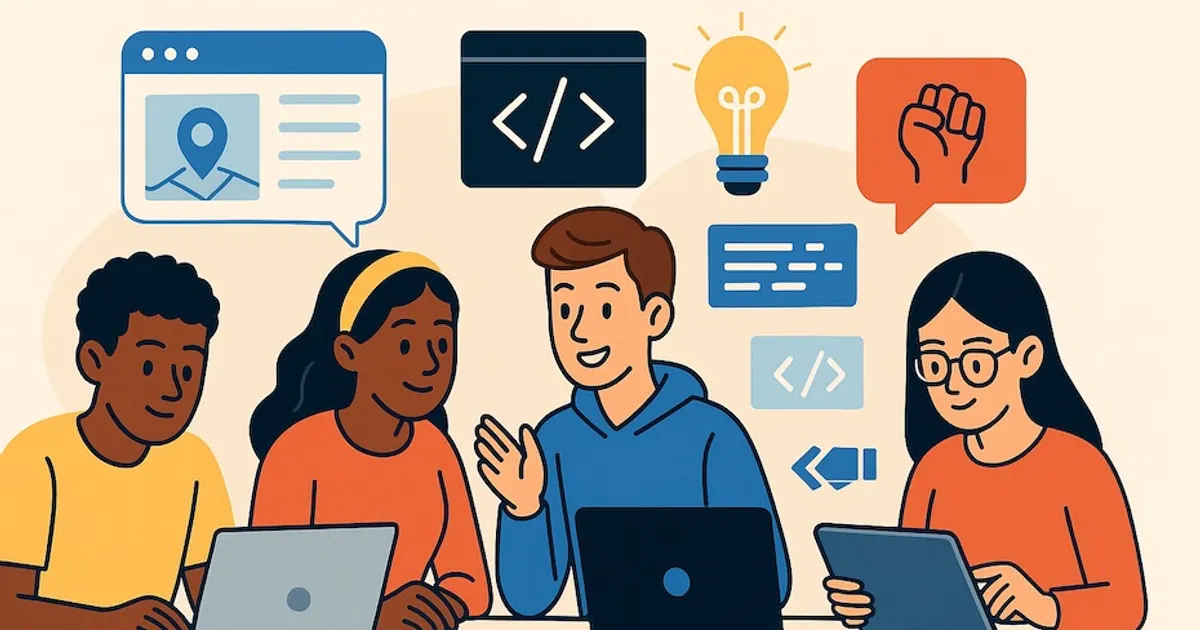
Students are using tech to solve real community problems—from designing apps to mapping pollution, creating AI tutors, and amplifying voices through media tools.
This article walks you through ten real-world methods students use to apply their tech skills toward measurable change. You’ll see how peers are solving issues in education, environment, health, and local governance while learning high-impact digital skills.
1. Deploying Environmental Sensors and AI Tools
You collect environmental data using open-source sensors and apply AI to identify patterns. That gives local leaders a clear picture of public health risks. Students in wildfire-prone areas have built sensor stations that track particulate matter and wind changes, feeding real-time dashboards to school officials and emergency responders.
One successful project used low-cost air sensors and visual dashboards to reveal high-smoke zones during fire season. Once the data was published, it led to improved shelter-in-place protocols and air filtration initiatives in nearby schools. Through this, you gain skills in machine learning, data visualization, and public communication—while your community gains vital intel.
2. Building AI Tutors for Underserved Peers
You create AI-powered tutoring platforms using natural language processing and adaptive learning models. These digital tutors support students who lack access to live instruction, especially in low-income or rural areas. They’re trained on local curricula and designed for mobile access.
At several STEAM coding camps, students developed chatbots that explained math concepts in multiple languages. Others built automated Q&A systems for test prep. The impact is twofold: underserved students benefit from accessible help, and you gain applied machine learning experience through a socially impactful use case.
3. Creating Accessibility Tech for Seniors or Disabled
You build tools like voice-activated assistants, reminder apps, or computer vision interfaces to support people with disabilities or elderly users. These include AI companions that help track medication schedules or mobile apps with text-to-speech overlays for visually impaired individuals.
One student team created a facial recognition tool to assist Alzheimer’s patients in identifying loved ones, reducing caregiver strain. Others coded apps that convert video content into accessible formats. These tools don’t just fill technical requirements—they provide autonomy and inclusion for segments often left behind in the digital age.
4. Using Photovoice to Document Local Issues
You leverage the power of imagery and storytelling to bring local issues to the forefront. With Photovoice, students photograph community conditions—broken sidewalks, unsafe intersections, neglected spaces—and pair them with first-person captions.
In dozens of campaigns across U.S. school districts, these visuals have been used in presentations to city planners, school boards, and grant committees. This method is low-cost, high-impact, and easily accessible. It also trains you to communicate effectively with both emotional appeal and data, giving officials the perspective they need to take action.
5. Engaging in Community Mapping and Digital Surveys
You use geolocation tools and collaborative mapping platforms to survey public spaces and capture citizen feedback. That includes tagging unsafe areas, broken infrastructure, or underused facilities on interactive digital maps.
Through apps like Maptionnaire or ArcGIS StoryMaps, students build annotated public maps that get shared with local departments and urban planners. In one project, middle school students surveyed walking paths and bus stops in underserved neighborhoods. Their results led to upgraded lighting and improved bus schedules. The technical value is strong, but the civic influence is stronger—you’re shaping decisions that affect everyday safety and mobility.
6. Running Game-Based Social Challenges
You use game development platforms to design and release interactive titles focused on social or environmental topics. Whether using Unity, Scratch, or Roblox Studio, students create challenges that teach climate science, media literacy, or empathy.
Through the Games for Change Student Challenge, teens have developed games on topics like refugee experiences or ocean plastic. These projects get showcased in national competitions and used in classrooms. Building a game lets you fuse storytelling, coding, and social science—then deliver the message through engagement instead of lectures.
7. Joining Coding Camps for Cultural Empowerment
You enroll in coding and AI camps focused on preserving native culture or endangered languages. At Lakota AI Code Camp, Indigenous students learned to build mobile apps that taught tribal plants, native terms, and oral histories.
Through this format, you’re not just gaining exposure to Python or TensorFlow—you’re anchoring that knowledge in cultural preservation. You collaborate with elders, crowdsource tribal knowledge, and turn digital tools into vessels for memory. That transforms you into a creator of continuity, not just code.
8. Leveraging Social Media for Local Activism
You use platforms like Instagram, TikTok, YouTube, and podcasts to organize around local issues, amplify campaigns, and document calls to action. Whether through educational explainer videos, digital petitions, or protest coordination, students are making their voices heard.
A notable case came when high schoolers led local walkouts demanding safe school reopenings. They built follower bases, shared real-time updates, and mobilized thousands—all through their phones. Social media doesn’t just provide reach; it provides infrastructure for peer-to-peer organizing and rapid response.
9. Partnering with NGOs to Expand Tech Access
You join hands with nonprofit tech organizations that distribute learning tools, deploy mobile education platforms, or install offline learning networks in remote locations. In some regions, students volunteer to translate digital modules or teach tech literacy workshops.
In Indonesia, youth worked with NGOs to create phone-based radio-style lessons for isolated island communities. You gain a global understanding of inequality and the operational tech needed to bridge those gaps. These partnerships also build credibility and give your tech work broader sustainability.
10. Collaborating Through Peer Learning Networks
You participate in coding clubs, Discord channels, and local innovation labs where students trade skills, offer project feedback, and teach each other new tech stacks. This community-led learning accelerates mastery and spreads best practices.
Peer mentorship in these networks isn’t just academic—it’s a form of infrastructure. It builds accountability, raises expectations, and fosters scalable solutions. You learn to pitch ideas, critique UX, debug each other’s code, and coordinate collaborative rollouts. That’s the skill set of a future-ready civic technologist.
How Do Students Use Tech to Improve Communities?
- Build AI and sensor tools to solve real-world problems
- Design educational games and accessible learning platforms
- Use digital media, surveys, and mapping to influence civic action
In Conclusion
You’ve now seen ten powerful methods that students are using to drive real-world change with tech—across accessibility, environment, culture, and education. Each tool isn’t just about skill-building—it’s about influence. When you connect technical learning with civic purpose, you build a future where community action and innovation go hand in hand.
For more insights on leveraging technology for community solutions, connect with Suneet Singal on LinkedIn →. Join discussions on civic tech initiatives, youth-led innovation, and partnerships that amplify student-driven change.