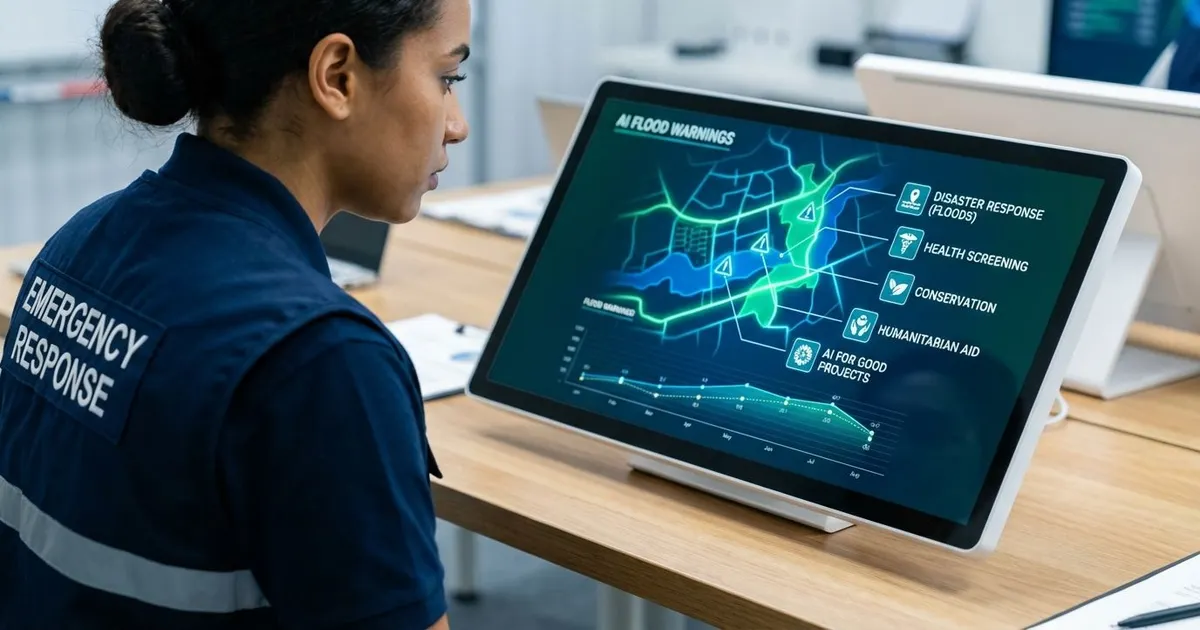
AI for good is already saving lives and money when it’s embedded into field operations: better flood warnings before rivers overtop, faster diabetic eye screening where specialists are scarce, continuous rainforest monitoring without constant patrols, and cleaner humanitarian data-sharing that reduces duplicate aid.
This article breaks down five real tech projects that have moved beyond demos and into day-to-day use. You’ll get the operational details that matter when you’re deciding what to fund, deploy, partner on, or replicate, including where the systems perform well, where they’re still constrained, and what “proof of work” looks like in the metrics.
Project 1: Google Flood Hub, AI Flood Forecasting For Disaster Preparedness
Flood operations reward time. If you can move from “hours of warning” to “days of warning,” you unlock a different playbook: staged evacuations, earlier road closures, sandbag distribution, hospital readiness, and pre-positioned supplies that actually arrive before bridges fail.
Google’s Flood Hub is built around AI-driven river flood forecasting that aims to expand reliable lead time out to up to seven days for many locations, with forecasts updated daily. The work is designed to scale globally, including regions that lack dense river gauge networks, which historically kept high-quality forecasting concentrated in a limited set of countries. When you’re planning risk communications, that daily refresh cycle matters, it gives emergency managers a cadence for briefings and reduces reliance on one-off “best guess” alerts.
The project’s most practical contribution is the way it treats coverage tiers. You get areas with verified data coverage, additional reach using virtual gauges in data-scarce regions, and an expert data layer that supports professional use where validation is still limited. If you’ve ever had to defend an alert program publicly, this separation is a real governance advantage: it helps you message uncertainty without hiding it, and it protects trust when the system is operating at the edge of available ground truth.
At scale, Flood Hub reporting describes reach to users in 100+ countries with verified data and broader basin coverage across 150+ countries, with an estimated reach on the order of hundreds of millions of people. That scale doesn’t remove the need for local disaster agencies, it amplifies them when the right workflows exist: clear thresholds, defined handoffs, and a communications plan that matches what the model output actually means.
Project 2: AI Diabetic Retinopathy Screening, AFMS And AIIMS “MadhuNetrAI” Rollout
Diabetic retinopathy is a logistics problem as much as a medical one. Too many patients don’t get screened early, too many screenings take too long to route to the right clinician, and too many health systems burn specialist capacity on cases that could have been triaged faster. The tech that changes outcomes is the tech that changes throughput.
India’s Armed Forces Medical Services described a rollout of AI-based community screening for diabetic retinopathy using handheld fundus cameras and the AI platform “MadhuNetrAI” developed by AIIMS New Delhi. Operationally, that’s a proven pattern: capture retinal images at the primary-care edge, run automated screening, then route positive or uncertain results into a referral pathway. When deployments fail, it’s usually not model performance alone, it’s the referral friction, device uptime, training gaps, and data capture inconsistencies.
Rollouts like this also surface the user concerns that drive adoption. Patients care about price and speed, and clinicians care about whether AI screening is being confused with a full eye exam. If screening is marketed carelessly, trust takes a hit. If screening is positioned precisely as triage that expands access and accelerates referrals, it earns allies inside clinics instead of creating a turf war.
The AFMS description emphasizes reaching underserved areas, training personnel for sustainability, and using the generated data to inform public health decisions. That last part is where executive teams should pay attention: once screening becomes routine, population-level data quality can improve, and that can change how you plan capacity, mobile clinics, and preventive programs across districts.
Project 3: Forest Listeners, Crowdsourced Bioacoustics For Rainforest Health
If biodiversity monitoring relies on periodic human surveys, you get snapshots. Illegal logging and habitat disruption don’t operate on survey schedules. Acoustic monitoring can operate continuously, and AI helps turn massive audio volumes into usable signals without requiring an expert to listen to every minute.
Forest Listeners is a Google Arts & Culture experiment built with Google DeepMind and partners including WildMon. The mechanism is simple and operationally relevant: people listen for species calls in Brazilian rainforests and label whether they hear a target call. Those labels become training data that improves automated identification at scale. It’s citizen science with a direct path to model improvement and, downstream, to more practical monitoring tools for conservation teams.
The project’s technical anchor is its connection to DeepMind’s Perch model for sound-based species identification, with the experiment using a large audio corpus described as over 1.2 million recordings. For a conservation org, the most important takeaway is not the web experience, it’s the production pattern: continuously gathered audio, fast labeling loops, model refinement, and field-ready outputs that help decide where to focus limited patrol and restoration resources.
When this type of system is implemented well, it supports near-real-time mapping of species presence indicators and can help verify whether restoration areas are trending healthier over time. That is the kind of metric funders and regulators actually respond to, because it ties monitoring directly to measurable intervention targeting.
Project 4: Cornell Lab Bioacoustics And A Foundation Model For Natural Sounds
Public-facing experiments help awareness. Field deployments need rugged hardware, reliable inference, and communications that work where connectivity is poor. The Cornell Lab work described in a Bezos Earth Fund-supported effort points directly at those field realities: recorders that can analyze audio in real time in the field, then report what’s happening back to teams that can act.
The Cornell description targets two threatened biodiversity hotspots, Guatemala’s Maya Biosphere Reserve and Brazil’s Pantanal. These aren’t easy monitoring environments. Threats include deforestation, fires, and poaching, and traditional monitoring falls behind because it’s labor-intensive and too intermittent. Real-time acoustic reporting changes the response loop, it supports earlier detection of pressure patterns and can help prioritize enforcement or community interventions based on fresh signals instead of last month’s observations.
The most strategic piece is the plan to build a foundation model for natural sounds. If that effort succeeds, it reduces the “custom model tax” that makes bioacoustics hard to scale across geographies. Instead of retraining from scratch for every new habitat and species mix, teams can adapt a shared base model faster. That shortens deployment timelines, reduces dependence on scarce ML talent, and improves consistency when multiple partners need comparable outputs.
Executives evaluating conservation tech should watch three criteria here: field compute constraints, how the system handles rare species calls without drowning in false positives, and how outputs integrate into real decisions. Acoustic AI is only valuable if the alert pipeline connects to action, patrol routing, local partner engagement, or enforcement triggers that are defined and resourced.
Project 5: WFP Building Blocks, Blockchain For Aid Coordination And Deduplication
Humanitarian operations suffer when organizations can’t see overlap. People get asked to re-register, families receive duplicative support while others get missed, and donor dollars leak into transaction fees that don’t improve outcomes. Coordination is the value, and the tech succeeds when it reduces friction without creating new administrative burden.
The World Food Programme’s Building Blocks is described as the humanitarian sector’s largest blockchain-based system, designed to reduce duplication and enable secure, real-time coordination across participating organizations. In practice, the business case is the operational math: fewer duplicate cases, cleaner handoffs across assistance types, faster reconciliation, and lower transaction costs.
WFP Innovation reports scale indicators that are hard to ignore: 4M+ people supported every month, US$555M in cash-based transfers processed to date, and US$3.5M saved in bank fees to date. It also reports that in Ukraine the platform was used by 65 organizations and contributed to US$67M in savings in one year by reducing duplication across assistance categories. Those numbers matter because they show what executives need to see: recurring operations, measurable savings, and multi-organization governance, not a one-off pilot.
If you’re evaluating a similar system, focus on what Building Blocks emphasizes operationally: neutral participation where members co-operate the network, clear rules for what data is shared, and workflows that reduce complexity for people receiving assistance. When data-sharing design is careless, trust erodes fast. When it’s designed around minimizing repeated registrations and preventing overlaps, it can raise both equity and efficiency.
Where AI For Good Projects Break Or Scale In The Real World
Across these five projects, deployment success looks consistent. You need reliable input pipelines, clear thresholds for action, and ownership that sits with the operational team, not just the data team. Flood forecasting requires defined alerting responsibilities across agencies. Health screening requires dependable referral paths and image quality control. Bioacoustics requires field hardware maintenance and a plan for false positives. Aid coordination requires governance agreements that survive leadership changes.
Measurement discipline is also non-negotiable. The metrics that matter are not model-centric. They are operations-centric: lead time gained, households reached, percent of screened patients who complete referral, duplicate cases prevented, transaction fees avoided, days saved in staff work, or patrol hours redirected to higher-risk zones. When reporting focuses on those outcomes, funding conversations get easier and partner alignment improves.
Procurement and partnerships also decide scale. Many “AI for good” deployments rely on government, UN, and NGO relationships because the beneficiaries aren’t typical app users. That means your rollout plan has to anticipate training, device lifecycle, multilingual support, data agreements, and auditability. If the project can’t be explained in a procurement committee meeting, it won’t survive budget season.
AI And Energy Systems: The Grid Is A Constraint And A Use Case
AI sits on both sides of the energy equation. It drives load growth through data centers, and it can help optimize planning, permitting, and grid operations. If you’re running strategy in this space, the honest position is that demand pressure is already influencing market outcomes, while optimization efforts are racing to catch up.
The U.S. Department of Energy highlights AI opportunities in grid planning using high-resolution climate datasets, in grid resilience through faster pattern detection for disruptions, and in permitting support via tools that can speed review workflows. These are practical levers because they target bottlenecks that executives already track: interconnection queues, siting timelines, and the staffing limits inside permitting agencies.
On the constraint side, PJM’s capacity market reporting for its 2027/2028 auction shows just how tight things are becoming: the auction cleared at the $333.44/MW-day cap, procured 134,479 MW, and still came in short of PJM’s reliability requirement by 6,623 MW. PJM also attributed a large share of forecast peak load growth to data center demand, with roughly 5,100 MW of an approximately 5,250 MW increase tied to data centers. If grid constraints are part of your AI-for-good strategy, projects that improve efficiency, flexibility, and better planning cycles are not “nice to have.” They are viability tools.
What Are Five Real “AI For Good” Tech Projects In Use Today?
- Google Flood Hub, AI flood forecasts up to 7 days ahead
- AI diabetic retinopathy screening (AFMS + AIIMS MadhuNetrAI)
- Forest Listeners, crowd-labeled rainforest audio to train species ID AI
- Cornell real-time bioacoustics + foundation model for natural sounds
- WFP Building Blocks, blockchain coordination that cuts duplicate aid
Put These Patterns To Work In Your Own Organization
These projects succeed because they treat AI as an operational asset: they connect data capture to decisions, decisions to actions, and actions to measurable outcomes. If you’re selecting a project to replicate, prioritize the one where your organization already controls the workflow end-to-end, since governance gaps kill more deployments than model errors. Build the measurement plan before rollout, then tie it to budget renewals, partner reporting, and frontline training so performance doesn’t depend on a few champions. The strongest next step is to pick one domain, disaster alerts, screening, conservation monitoring, or aid coordination, then map the exact handoffs where time and trust are lost today. Once those handoffs are defined, the right model choice becomes a procurement detail instead of the entire strategy.
References
- Google Research: An Improved Flood Forecasting AI Model, Trained And Evaluated Globally
- Google Flood Forecasting And Flood Hub
- AFMS AI-Based Diabetic Eye Screening Rollout (MadhuNetrAI)
- Google Blog: Forest Listeners
- Google Arts & Culture: Forest Listeners Experiment
- Cornell Chronicle: AI Innovations To Monitor And Protect Wildlife
- WFP Innovation Accelerator: Building Blocks
- U.S. Department Of Energy: How AI Can Help Clean Energy Meet Growing Electricity Demand
- PJM Inside Lines: 2027/2028 Auction Procures 134,479 MW
- UNICEF Office Of Innovation: Magic Box