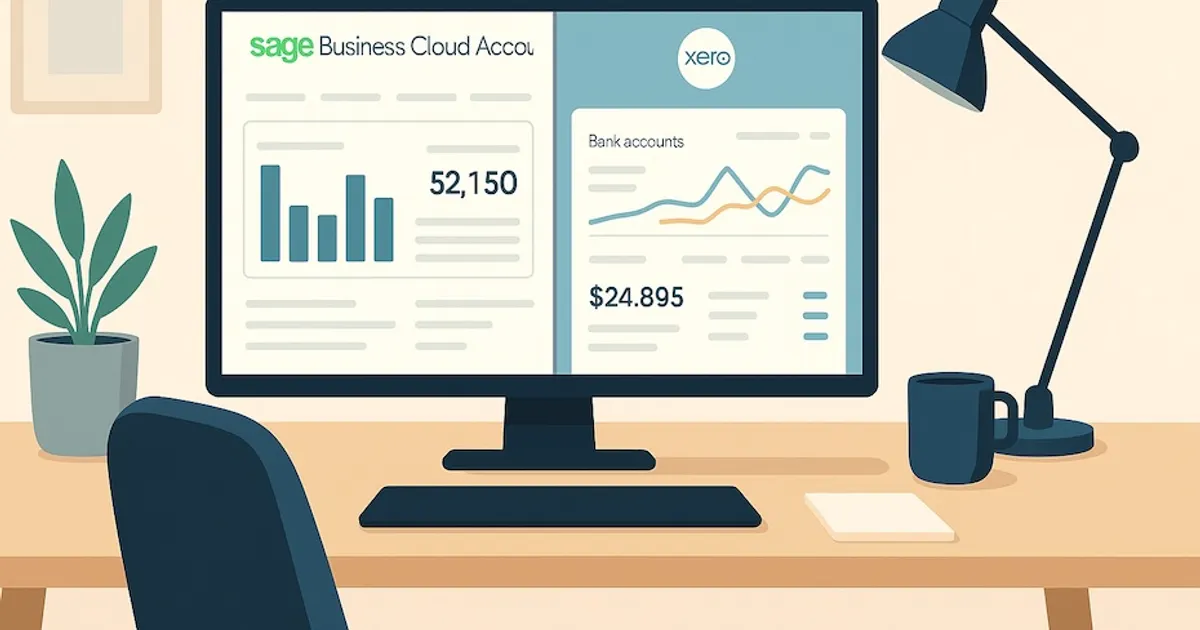
Xero scales better with unlimited users, transparent pricing, and extensive integrations, while Sage Business Cloud Accounting supports mid-size firms needing advanced reporting, strict controls, and industry-specific workflows.
This comparison highlights how Sage and Xero meet the unique demands of mid-size businesses. You’ll explore scalability, pricing transparency, feature depth, integrations, usability, and reporting, so you can select the platform aligned with your operational complexity and growth plans.
Which accounting software scales better for mid-size businesses?
Xero offers superior scalability with its unlimited user model and predictable pricing. You can add 20 or 200 employees without paying per-user fees, making it cost-effective for growing teams.
Its three-plan structure—Early at $13/month, Growing at $37/month, and Established at $70/month—ensures you move up tiers only when transaction volume or advanced features demand it. Larger mid-size firms benefit from multi-currency support, project tracking, and bulk reconciliation as they expand.
Sage scales differently. It emphasizes feature depth, starting around $21/month but requiring higher-tier plans for essentials like inventory management and multi-currency. You may also face per-user costs, meaning a 15-person finance team could spend $300/month in licenses, while Xero would cover the same group at $70/month.
Xero’s global support, extensive app marketplace, and consistent performance under heavy transaction loads make it more scalable overall. Sage suits firms with complex needs but may introduce cost and performance hurdles as you expand.
How do Xero and Sage pricing models compare for growing companies?
Xero’s pricing is transparent and predictable. Each plan includes unlimited users, reducing surprises in long-term budgeting. A mid-size firm can plan upgrades confidently, knowing the Established plan caps at $70/month.
Sage uses a region-dependent pricing structure. While its Accounting Start plan begins near $21/month, most mid-size firms need higher tiers, often $50–$100/month, plus user-based fees. Add-ons like advanced inventory or multi-currency may increase total cost by 50% or more.
Payroll costs also diverge. Xero partners with Gusto, offering payroll starting at $40 plus $6 per employee—roughly $220/month for 30 employees. Sage payroll typically runs $300–$500/month for similar headcounts.
Training and implementation compound costs. Xero’s intuitive setup keeps implementation under $2,000, with training typically under $1,000 for teams. Sage requires $5,000–$15,000 in consulting and $3,000–$8,000 in training due to its complexity.
If you need predictable costs and faster ROI, Xero delivers. If your firm values advanced capabilities over budget control, Sage justifies the higher investment.
What are the key feature differences between Xero and Sage for mid-size firms?
Xero emphasizes automation and accessibility. Its machine-learning reconciliation reduces manual entry by up to 80%, and its invoicing system automates reminders and integrates payments through Stripe or GoCardless. Expense tracking is simplified via mobile receipt capture, making it ideal for firms with mobile teams.
Sage emphasizes control and compliance. Granular user permissions, multi-phase project invoicing, and retention management fit firms with regulatory demands or project-based billing. Its expense management includes multi-level approvals and department-specific budgets for stricter oversight.
Project and inventory management show the sharpest differences. Xero offers basic project profitability tracking and standard inventory control. Sage handles sub-project hierarchies, detailed cost allocation, and advanced inventory features like FIFO, LIFO, and multi-warehouse tracking.
If you need advanced job costing, manufacturing workflows, or compliance-heavy reporting, Sage outperforms. If you want automation and ease for general accounting tasks, Xero excels.
Which platform offers better integrations for mid-size business workflows?
Xero dominates with over 1,000 integrations. Its open API lets you connect CRM, payroll, e-commerce, and industry-specific tools seamlessly. Shopify, HubSpot, and Gusto are just a few high-value integrations that reduce manual data entry and improve cross-team workflows.
Sage offers around 40 integrations, focusing on Microsoft Office, payroll providers, and industry basics. This smaller ecosystem ensures reliability but limits flexibility for rapidly growing firms with evolving needs.
For e-commerce, Xero connects to major platforms like Amazon, Shopify, and WooCommerce, automatically syncing sales and inventory. Sage handles standard transactions but lacks deeper multi-channel capabilities.
If integration flexibility is a priority, Xero clearly wins. If your workflows are stable and require fewer moving parts, Sage’s focused connections may suffice.
How do the user interfaces compare for team productivity?
Xero’s interface is modern, visual, and intuitive. Dashboards show KPIs through charts and graphs, so non-financial managers can interpret cash flow, receivables, and expenses at a glance. New hires usually gain proficiency in under a week.
Its mobile app mirrors the desktop experience, enabling sales staff to invoice immediately, field workers to log expenses, and managers to approve on the go. Mid-size firms report 40% faster invoicing and 60% better expense accuracy with Xero’s mobile tools.
Sage offers a more traditional accounting interface. Its design appeals to finance professionals who need detailed control but often overwhelms non-accountants. Training typically spans three to four weeks, and advanced customization requires IT support.
If simplicity, mobile productivity, and fast adoption matter most, Xero has the edge. Sage supports deep control but at the cost of a longer learning curve.
Which software provides better reporting and analytics for mid-size firms?
Xero reports prioritize accessibility. Standard statements like P&L, balance sheet, and cash flow are visually presented for quick comprehension. Color-coded aging reports and interactive dashboards allow managers to spot issues quickly.
Sage delivers depth. You gain audit-ready statements, compliance reporting, budget variance analysis, and industry-specific reports for construction, manufacturing, or engineering. Its custom report builder enables complex financial modeling, though it often requires professional training or support.
Xero suits leaders who need fast, visual insights to drive decisions. Sage is the better fit for finance teams needing advanced analytics, detailed audit trails, or compliance-ready documentation.
What do mid-size businesses say about customer support and implementation?
Xero emphasizes self-service, with extensive tutorials, forums, and community-driven support. Email support resolves most issues within 24–48 hours, and implementation usually finishes in two to four weeks internally, keeping setup costs low.
Sage provides direct support with knowledgeable accounting specialists, available by phone or email. Implementation takes four to eight weeks and often requires consultants, raising costs but ensuring detailed configuration.
Mid-size businesses report smoother onboarding and faster adoption with Xero. Those needing customized setups and expert-led training find Sage more reliable, albeit slower and costlier to implement.
Which Platform Wins for Mid-Size Firms?
- Choose Sage for compliance, profitability tracking, and structured reporting.
- Choose Xero for usability, integrations, and unlimited-user scalability.
Making Your Final Decision
You should align your choice with your firm’s priorities. If growth scalability, usability, and integration flexibility lead your strategy, Xero is the clear option. If your firm operates in complex industries where compliance and advanced analytics dominate, Sage offers the precision you need. Test both through free trials, involve your team in evaluation, and choose the system that strengthens both your current workflows and long-term ambitions.
For more insights on accounting software, digital transformation, and business strategy, explore my Quora profile, where I share practical guidance and detailed comparisons to help firms make smarter technology and growth decisions.