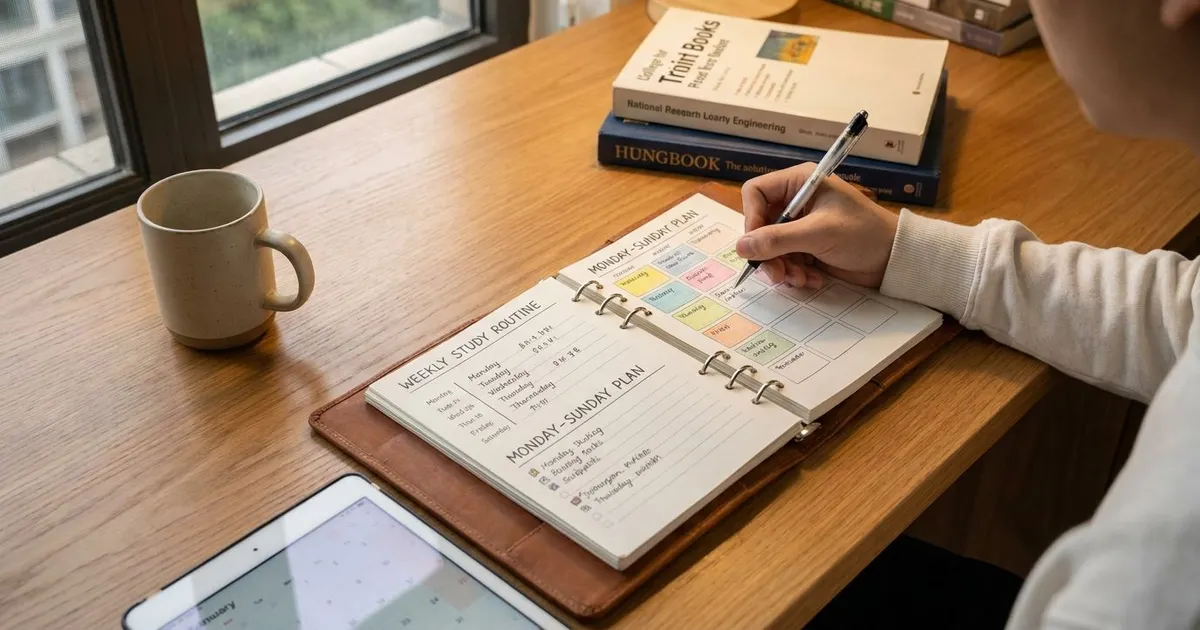
You stay motivated through the academic year by building systems that keep you moving when your mood dips: clear goals, weekly planning, small daily starts, and recovery that protects your energy. Motivation lasts when you stop treating it like a feeling and start managing it like a routine.
If you want steady academic momentum, you need more than a strong first week and a color-coded planner. You need a repeatable way to handle deadlines, procrastination, stress, and the mid-semester drop that catches so many students off guard. This guide shows you how to create that structure, reset when you lose steam, and keep your effort steady without running yourself into the ground.
What Actually Keeps You Motivated Beyond The First Few Weeks?
Early-semester motivation is easy to trust because everything feels fresh. New classes, new notebooks, new schedules, new intentions. The problem is that novelty fades fast, and when it does, you’re left with the part that really matters: what you do on ordinary days when nothing feels exciting.
That’s why long-term motivation comes from routine, not emotion. You need a system that tells you what to do before you start negotiating with yourself. Fixed study blocks, a short weekly planning session, and a visible list of priorities reduce decision fatigue. When your work already has a place in your calendar, you waste less energy trying to “get in the mood” to begin.
You also stay motivated longer when your reasons for doing the work feel personal. If a class matters only because it’s required, your effort becomes fragile. If you connect it to something you value, a graduate program, a career skill, financial stability, confidence in a subject you’ve avoided, your follow-through gets stronger. That kind of motivation holds up better when the semester gets busy because it isn’t built on hype.
There’s another piece students often ignore: life outside class. When your week includes exercise, meals at regular times, a club, a shift, family responsibilities, or even one planned social commitment, your schedule gains shape. Those outside commitments can work in your favor. They force you to plan earlier, protect time better, and stop letting assignments drift until the last minute.
How Do You Build A Weekly Routine That Keeps You Going?
A workable weekly routine doesn’t need to look perfect. It needs to be repeatable. You want a rhythm you can carry through a normal week, a hard week, and a week when you’re tired and annoyed and still have to submit the paper. That means your routine should lean on consistency, not intensity.
Start with one planning block each week, around thirty to forty-five minutes. During that time, list every deadline, reading, quiz, meeting, and work shift you already know about. Estimate how long each academic task will take, then place that work into your calendar before the week starts. This keeps your workload visible and prevents the common mistake of assuming you’ll “fit it in later.” Later is where motivation goes to disappear.
Your daily routine should be smaller and simpler. At the start of each day, choose your top two academic priorities. Not six, not a vague list of everything you should eventually touch. Two clear tasks that matter. Then define the first action for each one. “Study chemistry” is too broad. “Complete ten practice problems from chapter four” works. “Write history essay” is too broad. “Draft the introduction and pull two quotes from the reading” works.
At the end of the day, spend two or three minutes setting up tomorrow’s starting point. Open the document, leave the textbook on the desk, write the next step on a note, queue the article you need to read. This matters more than students think. Starting is where most resistance shows up, so you want tomorrow’s version of you to face as little friction as possible.
You also need breaks built into the plan. Not random scrolling, not accidental procrastination that turns into an hour. Real breaks. A walk, lunch away from the screen, a workout, a call, a short reset. If you schedule work as if you’re a machine, your routine won’t last. You’re managing energy as much as time, and your routine needs to reflect that.
How Can You Stay Motivated When You Feel Burned Out Mid-Semester?
When you hit burnout, your first move is not to push harder. Your first move is to reduce overload and recover enough stability to function again. Many students make the same mistake at this point: they fall behind, panic, and respond by trying to do everything at once. That usually makes the slump worse.
Instead, narrow your focus to the next twenty-four to forty-eight hours. Pick one or two high-impact tasks and complete those first. A quiz due tomorrow, the discussion post that keeps your grade from slipping, the reading you need before class, the email you’ve been avoiding to a professor or tutor. Small wins matter here because they lower the emotional pressure and restore a sense of control.
You should also do a quick workload audit. What can be postponed, shortened, or dropped? What must stay? What support do you need? A lot of academic stress comes from carrying ten open loops in your head and treating them as equally urgent. They aren’t. Once you sort them, the pressure usually feels more manageable. If you need clarification, office hours, tutoring, writing support, or counseling services, use them early rather than waiting until the situation gets worse.
Burnout also feeds on vagueness. Large, undefined tasks drain you before you begin. So shrink the work until it feels movable. Read three pages. Solve two problems. Outline one paragraph. Review one lecture. Tiny starts aren’t a gimmick. They interrupt the paralysis that keeps work stuck in your head and convert dread into action.
You can’t ignore the physical side, either. If your sleep is inconsistent, your meals are random, and you’ve been sitting indoors for days, motivation will feel weak even if your intentions are good. Recovery basics are not optional when you’re trying to finish a semester well. Sleep, movement, hydration, and regular eating patterns help restore concentration, patience, and emotional control. That doesn’t solve every problem, but it gives you enough footing to make better decisions.
What Does Research Say About Motivation That Actually Lasts?
One of the most useful research-based ideas for student motivation is Self-Determination Theory, which explains why some motivation holds up better than others. The short version is this: you stay engaged longer when three needs are supported, autonomy, competence, and relatedness. If you feel some choice in what you’re doing, believe you can improve, and feel connected to other people in the process, your motivation tends to be steadier.
Autonomy matters because people resist work that feels disconnected from their values. You may not control every assignment, but you can control how you frame it. Tie each course to a concrete reason that matters to you. Maybe it builds writing skill, sharpens analysis, supports your degree path, or removes a barrier to graduation. When you define a personal reason, the work stops feeling random.
Competence matters because motivation grows when you can see progress. If you keep studying in ways that give you no feedback, you’ll start to feel stuck. That’s why practice quizzes, problem sets, office hours, tutoring, draft reviews, and self-testing matter so much. They show you where you are, what needs work, and what’s improving. Progress is motivating when you can actually measure it.
Relatedness matters because motivation weakens in isolation. You’re more likely to keep going when someone else knows your goals, notices your effort, or works alongside you. Study groups, accountability partners, class friends, lab partners, or even a regular library session with someone who’s serious about school can stabilize your habits. You don’t need a huge support system. You need enough connection that your effort doesn’t feel like a solo grind.
Research on learning and self-regulation also points in the same direction: students do better when motivation is paired with planning, monitoring, and follow-through. That means goal-setting helps, but only when it leads to a real schedule. Positive thinking helps, but only when it leads to action. Motivation isn’t separate from strategy. It strengthens when your system makes progress visible and starting easier.
How Do You Stop Procrastinating When You Don’t Feel Like Studying?
Procrastination usually isn’t laziness. More often, it’s friction. The task feels too big, too unclear, too boring, too stressful, or too tied to the fear of doing poorly. When that happens, your brain looks for relief, and relief is easy to find in your phone, your kitchen, your group chat, or a sudden urge to reorganize your desk.
The fix is to reduce the friction at the start. You need a smaller entry point. Open the laptop, title the document, and write one rough sentence. Read one paragraph and highlight the main claim. Do three math problems and stop to reassess. Study for ten minutes with a timer instead of promising yourself two perfect hours. These short starts work because they lower resistance without lowering standards. You’re not avoiding the task. You’re entering it cleanly.
Your environment also matters more than your intentions. If your materials are scattered, your tabs are chaotic, and your phone is next to your keyboard, you’ve made starting harder than it needs to be. Put the book, notes, charger, and assignment in one place. Use website blockers if you need them. Close what you don’t need. Give yourself a work setup that supports action instead of competing with it.
It also helps to define what “done for now” means before you begin. A lot of procrastination comes from open-ended work. If you sit down with no finish line, the task expands in your head. Set a target: one flashcard set, one page of notes, one lecture review, one problem set section, twenty-five minutes of focused work. A clear stopping point makes it easier to start because your brain isn’t bracing for an endless session.
If procrastination has become a pattern, start tracking it without drama. Notice when it shows up, what subjects trigger it, and what story you tell yourself right before you avoid the task. That data helps you fix the actual cause. If you procrastinate because you’re confused, get help. If you procrastinate because the assignment feels too large, break it apart. If you procrastinate because you’re exhausted, address the exhaustion. Generic advice won’t solve a specific problem.
How Do You Stay Motivated When You’re Balancing School With Work, Family, Or Stress?
If you’re balancing classes with a job, caregiving, commuting, or ongoing stress, you can’t plan like someone with unlimited free time. A lot of motivation advice quietly assumes you have open afternoons, flexible weekends, and lots of energy left over. If that’s not your reality, you need a tighter system built around your actual constraints.
Start by calculating your real available study time. Not your ideal study time, your real study time. Once you subtract classes, work shifts, commute time, meals, sleep, and major responsibilities, you’ll see the number you actually have to work with. That number tells you how aggressive your course load can be and how carefully you need to prioritize. This is where students often gain relief. A realistic plan feels smaller, but it’s more honest and more useful.
From there, shift to grade-critical work first. Focus on assignments, exams, and participation requirements that carry the most weight. You still want to stay engaged with all your classes, but when time is tight, you need to protect the work that has the biggest effect on outcomes. That means fewer vague “study all evening” plans and more targeted blocks tied to specific deliverables.
Micro-sessions can also save your week. Review flashcards on your commute, listen to lecture notes between responsibilities, outline a response during a break, or use fifteen-minute gaps for admin tasks like checking due dates and sending emails. Short work blocks don’t replace deep study time, but they reduce pileup. They help you stay in contact with your courses, which keeps motivation from collapsing between long stretches of busyness.
You also need a fallback plan for rough weeks. Build a minimum-viable schedule you can use when life gets messy. That might mean two focused forty-five-minute work blocks, one short review block, and one admin block to handle communication and scheduling. A fallback plan keeps you from going fully off track when your usual routine breaks. If your standard plan is too rigid, one bad week can unravel the rest of the month.
If your stress starts affecting sleep, appetite, concentration, or your ability to function day to day, don’t treat that as a normal part of being a student. Use campus support services, counseling resources, academic coaching, advising, tutoring, or disability support if it applies to your situation. You don’t earn extra credit for carrying everything alone. Getting support earlier often prevents a temporary strain from becoming a full academic collapse.
What Should You Do When Your Goals Stop Feeling Important?
Motivation drops fast when your goals get stale or vague. You may still care about doing well, but if your goals haven’t been updated since the first week of the term, they can lose their grip. “Get good grades” won’t pull you through a hard month. It’s too broad, too familiar, and too easy to ignore.
Refresh your goals by making them specific and current. What exactly matters right now? Raising a grade in one course, passing a gateway class, submitting every assignment for the next three weeks, finishing the term without late penalties, keeping your scholarship, or building a stronger transfer application. Good goals create direction. Better goals create decisions. They tell you what deserves your attention today.
It also helps to split long-term goals from weekly performance goals. Your long-term goal might be finishing the year strong or qualifying for a certain opportunity. Your weekly goal is what gets you there: attend every lecture, submit all work on time, complete two review sessions before the exam, visit office hours once, or cut late-night cramming out of your routine. Long-term goals inspire. Weekly goals produce results.
Don’t leave your goals buried in a notes app you never open. Put them where you’ll see them, in your planner, on your desktop, on a card inside your notebook, or at the top of your weekly plan. Visibility matters. You’re more likely to stay aligned when your goals are present during the moments where you usually drift or avoid the work.
And be honest about whether the goal still belongs to you. If you’re chasing a standard that came from pressure, comparison, or fear, it may not generate steady effort. Goals with personal meaning usually last longer than goals tied only to external approval. You don’t need every class to feel inspiring, but your larger direction should make sense to you.
How Can You Recover Quickly After A Bad Week Or A Bad Exam?
A bad week doesn’t ruin your academic year unless you turn it into a pattern. The real risk is the emotional spiral that follows, the shame, avoidance, and silence that make one setback last longer than it should. Fast recovery matters more than perfection.
Start by gathering facts. What happened, exactly? Did you miss deadlines because your schedule was overloaded, because you procrastinated, because you didn’t understand the material, or because something outside school took over your week? If you don’t name the cause accurately, you’ll pick the wrong fix. A time problem needs scheduling changes. A confusion problem needs academic support. An energy problem needs rest and structure.
After that, make one repair move in each category: academic, logistical, and personal. Academic might mean emailing a professor, going to office hours, or reviewing an exam. Logistical might mean updating your planner and moving tasks into real time slots. Personal might mean getting to bed earlier for two nights, eating properly, or stepping away long enough to reset. Recovery works when it addresses the full picture, not just the grade.
You should also be careful with the story you attach to a setback. One low score doesn’t mean you’re bad at the subject. One sloppy week doesn’t mean you’ve lost discipline. It means something in your system broke down, and your job is to fix the system. Students who recover well don’t waste energy defending their identity. They adjust the process and move.
Then re-enter fast. Don’t wait until Monday, next week, or after you “feel ready.” Start with the next class, the next assignment, the next hour you have available. Momentum is easier to rebuild when the gap stays short. The longer you stay disconnected, the harder it feels to return.
What Helps You Stay Motivated All Year?
- Set clear weekly goals, not vague intentions.
- Use fixed study blocks so work has a home.
- Start tasks small to beat procrastination.
- Track progress, protect sleep, and use support early.
Keep Your Momentum, Don’t Wait For A Perfect Mood
You don’t stay motivated through the academic year by feeling inspired every day. You stay motivated by making your work easier to start, easier to track, and easier to recover from when things go sideways. When you build a weekly rhythm, connect your classes to real goals, and cut procrastination at the starting line, your effort becomes steadier and less dependent on willpower. Burnout, stress, and bad weeks will still show up, but they won’t control the entire semester if you know how to reset fast. Keep your system simple, visible, and honest, and you’ll give yourself something better than temporary motivation: you’ll give yourself momentum that lasts.
References:
- Academic Success Center, Purdue University
- Psychological & Counseling Services, University of New Hampshire
- College Counseling Services, University of West Alabama
- Pathways To Student Motivation: A Meta-Analysis Of Antecedents Of Autonomous And Controlled Motivations
- Enhancing Online Learning Outcomes Through A Theory-Driven Intervention
- Systematic Review Of Academic Procrastination Interventions In Computing Higher Education
- Reddit Discussion: How Do You Stay Motivated More Than A Few Weeks Into The Semester?