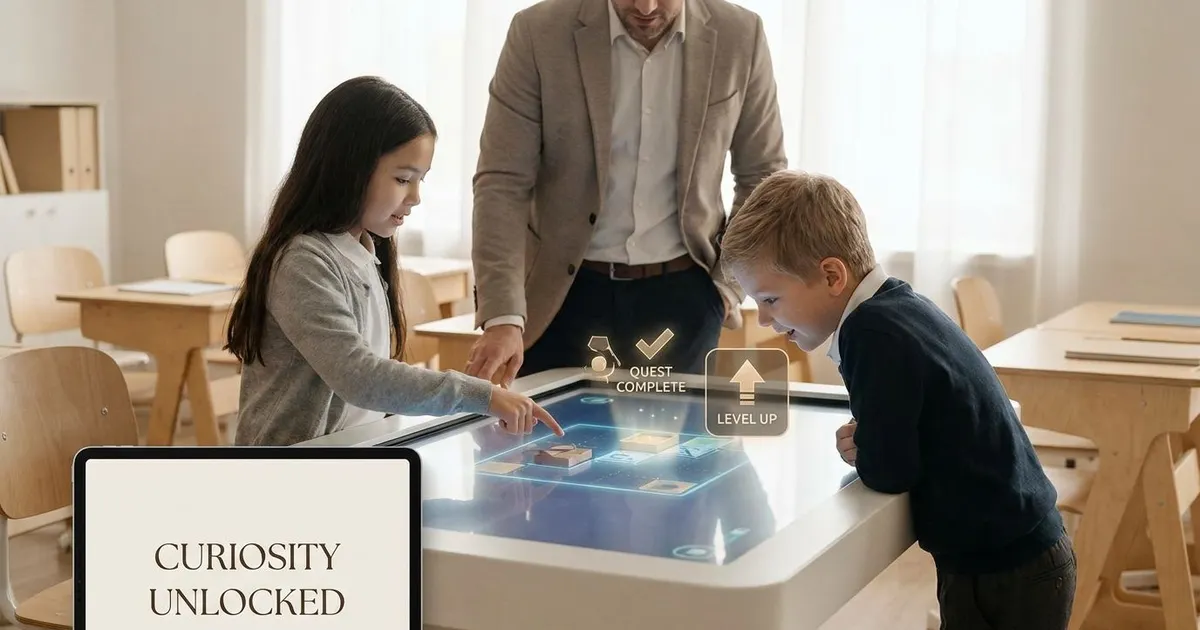
Gamified learning turns passive classroom time into active participation by giving students clear goals, meaningful progress, immediate feedback, and a reason to keep going. When you connect game mechanics to real learning tasks instead of using points as decoration, boredom starts giving way to curiosity.
If you want students to lean in instead of checking out, you need more than energy and enthusiasm. You need lesson design that creates momentum. This article shows you how gamified learning reduces boredom, which game elements raise engagement, where teachers often get it wrong, and how you can build curiosity without depending on screens or shallow reward systems.
How Does Gamified Learning Reduce Boredom In The Classroom?
Gamified learning reduces boredom by changing the role students play during instruction. Instead of sitting through content as observers, students move through challenges, unlock progress, make choices, and get feedback that tells them what to do next. That shift matters because boredom in class often grows when work feels repetitive, disconnected, or too predictable.
Research on gamification in education points in a consistent direction: game elements can improve motivation and engagement when they support the learning goal rather than distract from it. That means progress bars, quests, team missions, checkpoints, badges, mystery prompts, and timed challenges work best when they organize effort around a clear academic outcome. Students respond when the task feels active and structured, not when the lesson simply gets a cosmetic layer of fun.
You can see this in everyday classroom practice. A worksheet becomes more engaging when it is framed as a mission with milestones. A review session becomes more focused when students work through levels and earn access to more difficult questions. A reading activity becomes more compelling when students must collect evidence to solve a problem or reveal an answer. Boredom usually drops when students sense movement, purpose, and visible progress.
There is also a practical engagement factor at work. Students often disengage when they cannot tell whether they are succeeding, how long a task will take, or why it matters. Gamified structures solve those friction points by making expectations visible. When students know the objective, see their advancement, and understand the payoff for effort, they stay in the task longer and invest more attention.
That is why gamification is not just a motivation tool. It is a lesson-architecture tool. When designed well, it breaks long stretches of passive instruction into short cycles of action, response, and advancement. Curiosity grows when students feel that every step reveals something new or gets them closer to solving something worth solving.
Does Gamification Actually Improve Student Engagement And Learning?
Yes, the evidence supports the idea that gamification can improve student engagement and, in many cases, learning outcomes. The important detail is design quality. Students do not learn more just because a classroom uses points, badges, or a leaderboard. They learn more when those mechanics strengthen focus, repetition, retrieval, feedback, and sustained effort.
Meta-analyses in educational research have shown that gamification can positively affect motivation, engagement, and academic performance. A systematic review focused on school engagement also found gains across behavioral, emotional, and cognitive engagement. Those findings matter because boredom is rarely just a mood problem. It often signals weak emotional investment, limited mental effort, and low participation at the same time.
You should treat gamification as an amplifier. If the lesson already has a strong objective, clear criteria, and useful practice, game mechanics can increase attention and persistence. If the lesson is weak, gamification may only make students chase rewards without building understanding. That is why some teachers love it and others dismiss it. They are often reacting to very different levels of instructional quality.
Classroom experience backs this up. Teachers often report strong short-term gains from quiz competitions, point systems, and team challenges. Yet many also notice that those gains fade when the activities become predictable or when the reward becomes more important than the content. Students may play hard and still retain very little if the task asks only for speed, guessing, or surface recall.
The practical takeaway is simple. If you want gamification to improve learning, you must connect the mechanic to what students need to think about, practice, explain, or produce. Use points to reward evidence, not noise. Use levels to pace mastery, not just participation. Use badges to mark real accomplishment. When game mechanics reinforce academic behaviors that matter, engagement becomes useful rather than temporary.
What Game Elements Work Best For Turning Boredom Into Curiosity?
The strongest game elements for curiosity are the ones that create anticipation, uncertainty, agency, and progress. Students become more alert when they feel there is something to figure out, something to unlock, or a consequence tied to the quality of their work. Curiosity is fed by information gaps. Good gamified learning creates those gaps in controlled, purposeful ways.
Some teachers overvalue competition because it is easy to add. Competition can energize a room, but it does not always create curiosity. If the only mechanic is a leaderboard, students may focus on speed or status. Curiosity grows more reliably when you use inquiry mechanics: clues, puzzles, branching choices, hidden information, missions, case files, role-based tasks, and staged reveals. Those elements invite students to ask what comes next and what they are missing.
Progress systems also matter. Levels, checkpoints, unlocks, and visible milestones help students stay engaged because they can see movement. A student who feels stuck often disengages. A student who sees a sequence of manageable wins usually keeps going. That is why well-designed progression can do more for motivation than a flashy digital tool.
Choice is another major driver. When students can select a path, role, challenge type, or method of showing what they know, the work feels less imposed and more owned. Ownership is a strong antidote to boredom. It tells students that their decisions shape the experience, which raises commitment and attention.
Feedback closes the loop. Curiosity weakens when students act and get no response. It strengthens when the classroom system signals whether they are on track, what they just unlocked, or what they still need to solve. Immediate feedback keeps the task alive. Delayed or vague feedback drains momentum and makes the game structure feel artificial.
If your goal is curiosity, build around mystery, progress, and choice before you reach for badges and rankings. Reward mechanics can support a lesson, but inquiry mechanics usually carry the deeper engagement load. Students become curious when the class gives them a question worth answering and a path that keeps revealing more.
What Is The Difference Between Gamification And Game-Based Learning?
Gamification and game-based learning are related, but they are not the same. Gamification means adding game mechanics to a lesson or task. Game-based learning means the game itself carries the learning experience. If you blur that distinction, you can end up choosing the wrong tool for the result you want.
If you add points, streaks, team scoring, or badges to vocabulary practice, you are using gamification. If students learn through a simulation, role-play, escape-room sequence, strategy challenge, or structured academic game where the content is embedded in play, you are using game-based learning. One layers mechanics onto instruction. The other turns instruction into a game structure.
This difference matters because boredom does not always disappear with surface-level gamification. Many students respond well to quick bursts of competition, but those bursts can lose power when every lesson follows the same pattern. That is where game-based learning often has an advantage. It can create stronger curiosity because students are not just earning rewards around the content. They are learning through the content as they play, solve, negotiate, or investigate.
There is also a rigor issue. Some gamified tools center fast answers and simple recall. That can be useful for fluency and review, but it does not always support deeper thinking. Game-based learning often makes more room for strategy, discussion, failure, revision, and application. Those features help students stay engaged for longer stretches without needing constant external rewards.
You do not need to choose one forever. Smart classroom design uses both. Gamification works well for routines, retrieval practice, transitions, and short feedback loops. Game-based learning works well for projects, problem solving, simulations, inquiry units, and content that benefits from role, tension, or narrative structure. When you understand the difference, you can deploy each one with more precision and avoid the fatigue that comes from turning every lesson into the same kind of contest.
How Can You Spark Curiosity Instead Of Forcing Engagement?
You spark curiosity by designing the lesson so students notice a gap in what they know and feel motivated to close it. That is very different from telling students to care more, participate more, or be curious on command. Curiosity is easier to activate when the task opens with an unresolved question, a surprising detail, a missing piece of evidence, or a decision students need to make.
One of the strongest ways to do this is to begin with a problem before you begin with an explanation. Put students in contact with something incomplete. Show a result before the process. Reveal a claim before the proof. Present a scenario that demands interpretation. When students feel that something does not yet make sense, attention rises. Gamified learning strengthens that effect by tying the gap to a mission, clue trail, or staged reveal.
You also need scaffolding. Students do not automatically know how to generate good questions or sustain inquiry. Curiosity grows more steadily when you provide prompts, checkpoints, and visible places to capture what students notice and wonder. A question board, challenge map, clue log, or mission tracker can keep curiosity from evaporating after the opening minute of a lesson.
Agency plays a major role here. Students lean in more when they can choose which clue to investigate, which challenge to attempt first, which role to play in a team, or which evidence supports their answer. Forced engagement feels like performance. Curiosity feels like pursuit. Your lesson design should make students feel they are chasing understanding, not complying with enthusiasm.
You should also remove friction that blocks curiosity before it starts. If directions are muddy, pacing is slow, or the task feels too easy or too hard, students shut down. Curiosity needs a clean entry point. Students need to understand the mission, see the immediate first move, and feel that success is possible with effort.
That is where many gamified lessons succeed. They package the task in a way that makes the next move obvious and worthwhile. A clue to decode, a question to unlock, a level to clear, a case to solve, a team objective to complete. These structures do not force interest. They create conditions where interest can take hold.
What Are The Risks Of Gamified Learning In The Classroom?
Gamified learning can fail when the mechanic gets more attention than the learning. Students may become reward-focused, rush through tasks, or equate speed with mastery. If the system values points over thinking, many students will optimize for points. That is not a student problem. It is a design problem.
One risk is novelty loss. A leaderboard or quiz race may feel fresh the first few times, but repetition weakens the effect. Students start reading the structure faster than the content. Once that happens, engagement turns mechanical. You may still get noise, movement, and visible participation, yet very little genuine curiosity or durable learning.
Another risk is uneven participation. Competitive structures can energize confident students while discouraging quieter students, students who process more slowly, or students who already feel behind. If your game design rewards only speed and public victory, you can raise stress and lower effort for the students who most need a stronger connection to the lesson.
There is also the issue of shallow alignment. Some gamified lessons add badges, streaks, and progress bars to tasks that remain dull, unclear, or poorly sequenced. Students sense that quickly. When game elements do not change the actual learning experience, they feel decorative. That is one reason some teachers grow skeptical of gamification after using tools that produce excitement without much retention.
You can avoid most of these problems by setting non-negotiable design rules. Tie rewards to evidence of understanding. Mix competition with collaboration. Rotate mechanics so students do not live in a single format. Build in reflection, explanation, and revision. Keep the game element in service of the academic goal at all times.
Another safeguard is moderation. You do not need to gamify every minute to create a more engaging classroom. Some tasks should stay simple and direct. Some boredom comes from poor lesson design, but some comes from the normal effort of learning. Gamification works best when you use it to remove passive disengagement, sharpen focus, and create momentum where attention usually drops.
How Can You Use Gamified Learning Without Relying On Screens?
You do not need devices, apps, or online quiz platforms to build a gamified classroom. Screen-free gamification often works better because it raises movement, discussion, collaboration, and physical presence. If your students are already saturated with digital prompts, analog game structures can feel more immediate and more memorable.
You can build strong analog systems with surprisingly simple materials. Use task cards as quest cards. Turn review questions into clue chains. Create team missions with envelopes, locks, maps, role cards, challenge boards, stamp sheets, and progress trackers. Break a lesson into levels posted around the room so students advance only after meeting a success check. These formats make learning visible and active without adding screen fatigue.
Movement is one major advantage of offline gamification. Students who struggle to stay engaged during long seated instruction often respond well when tasks require them to circulate, sort, match, debate, retrieve evidence, or solve problems at stations. Physical progression reinforces mental progression. Students feel they are doing something, not just receiving something.
Screen-free structures also make collaboration easier to manage. Team roles can be assigned on cards. Progress can be tracked on a shared board. Clues can be distributed across groups so students depend on one another to complete the full task. That kind of interdependence strengthens attention because each student controls a piece of the pathway forward.
You can also create narrative tension without any technology. A history lesson can become a case file. A science lesson can become an investigation. A literature lesson can become an evidence mission built around interpretation. A mathematics lesson can become a sequence of unlocks where each solved problem reveals the next condition. If the work has purpose, sequence, and consequence, students do not need a screen to feel engaged.
Offline gamification gives you another benefit: flexibility. You can adjust pacing in real time, swap tasks quickly, and observe thinking more directly than you often can in app-based systems. That makes it easier to maintain academic rigor while still keeping the room energetic and focused. The method is not about technology. It is about design.
How Do You Design Gamified Lessons That Lead To Real Learning?
Start with the academic objective, then build the game mechanic around the behavior students need to perform. If the goal is retrieval, design for repetition and fast feedback. If the goal is analysis, design for evidence collection, decision making, and explanation. If the goal is problem solving, design for staged challenges and strategic choices. Learning comes first, and the game structure should sharpen it.
Define what students must know or do by the end of the lesson. Then decide what kind of tension will keep them moving. That tension might come from a mystery, a countdown, a team mission, a sequence of unlocks, a score target, or a role-based challenge. The point is not to make the lesson louder. The point is to make progress visible and effort meaningful.
Then build a progression path. Divide the lesson into small, purposeful steps. Students should know where they are, what unlocks the next move, and what counts as success. Progression reduces drift and gives students short-term wins that keep attention from collapsing. A long task without milestones often feels boring even when the content matters.
Feedback should be immediate and specific. Students need to know whether they solved the clue correctly, interpreted the evidence accurately, or completed the level with enough quality to move on. If feedback arrives too late, the game loses force. If feedback is vague, students stop trusting the progression system.
Build room for collaboration and reflection. Ask students to explain their choice, defend a solution, revise after a failed attempt, or compare strategies with a peer team. Reflection turns action into learning. Collaboration broadens participation and reduces the risk that gamification becomes a race dominated by a few outspoken students.
Measure the result with more than energy. A room can look engaged and still produce weak learning. Check recall, transfer, written explanation, quality of questions, and the ability to apply what was learned in a different format. If the game mechanic raises excitement but not performance, redesign it. If it strengthens attention, understanding, and follow-through, keep it and refine it.
What Is The Best Way To Turn Classroom Boredom Into Curiosity?
- Use game mechanics tied to learning goals.
- Create mystery, choice, and visible progress.
- Reward thinking, not just speed.
- Build short challenge cycles with feedback.
- Use screen-free quests when possible.
Make Curiosity The Engine Of Your Classroom
Classroom boredom rarely disappears because a lesson becomes louder, faster, or more entertaining. It fades when students can see a goal, feel progress, make decisions, and solve something that matters. Gamified learning works when you use it with discipline: align the mechanic to the objective, build curiosity into the task, and measure whether students learned more than they performed. If you design for mystery, momentum, and meaning, you give students a reason to stay with the work. That is where engagement gets stronger, and that is where curiosity starts doing the heavy lifting.
References
- https://link.springer.com/article/10.1007/s10648-019-09498-w
- https://www.frontiersin.org/articles/10.3389/feduc.2024.1466926/full
- https://www.sciencedirect.com/science/article/pii/S1747938X19302908
- https://www.edutopia.org/article/leveraging-curiosity-encourage-more-authentic-engagement
- https://www.kqed.org/mindshift/64964/gamification-fatigue-try-game-based-learning
- https://www.oecd.org/en/publications/pisa-2022-results-volume-ii_a97db61c-en/full-report/component-10.html
- https://www.gse.harvard.edu/ideas/ed-magazine/17/01/bored-out-their-minds
- https://www.reddit.com/r/Teachers/comments/1bh6s0v
- https://www.reddit.com/r/Teachers/comments/1ppi8fk/how_do_you_feel_about_gamification/
- https://www.reddit.com/r/instructionaldesign/comments/1stbhlr/unpopular_opinion_gamified_learning_in_most/
- https://www.reddit.com/r/teaching/comments/1835jrb/unpopular_opinion_asking_students_to_be_curious/