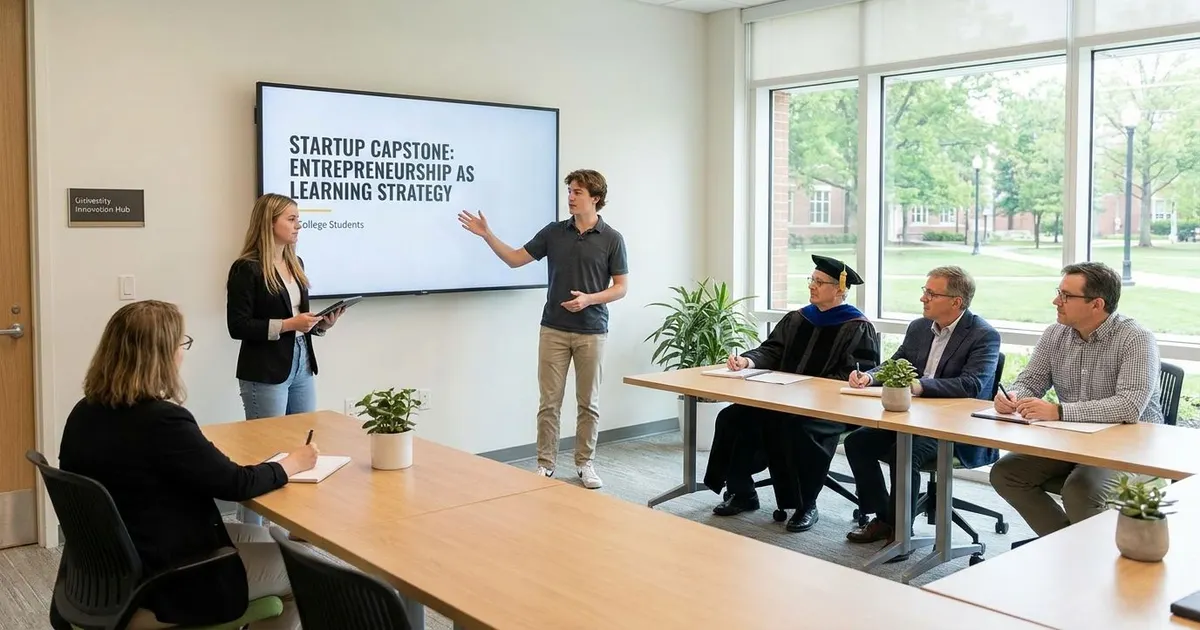
A startup capstone project can replace a traditional senior thesis when your college approves it as a credit-bearing project with clear academic outcomes, evidence, faculty supervision, and a final defense. The grade should measure what you learn, build, test, revise, and explain, not whether the venture becomes profitable.
Student entrepreneurship is moving from the business-club corner into the center of senior-year learning. Teen interest in business ownership is strong, and global student entrepreneurship data shows many college students are already building or attempting to build ventures. This article explains when a startup can work as a senior project, how universities structure it, how faculty can grade it, and how you can pitch the idea without making it sound like a shortcut.
Can A Startup Capstone Project Replace A Traditional Senior Thesis?
Yes, a startup can replace a traditional thesis when your department accepts venture creation as a valid academic project. You still need a research question, evidence, a work plan, faculty review, and a final presentation that proves learning.
The biggest misunderstanding is that a startup capstone means “launch a company and get credit.” A serious entrepreneurship capstone asks you to define a real problem, study users or customers, compare possible solutions, build a prototype or service model, and explain what changed after testing. That work can be as demanding as a long paper because it forces you to connect theory with decisions under pressure. You don’t get to hide behind polished language when your assumptions meet real people.
A traditional thesis usually rewards depth, argument, sources, and written analysis. A startup senior project adds execution: interviews, pricing choices, product decisions, team roles, market feedback, and financial reasoning. The stronger version blends both. You produce a venture and a written record that shows why your choices were academically sound.
Why Are Students Pushing For Entrepreneurship As A Senior Project?
Students are asking for entrepreneurship-based senior projects because they want proof of skill, not just proof of study. A venture gives you a concrete body of work you can show to faculty, employers, graduate programs, and future partners.
The interest is not fringe. A Junior Achievement survey found that most teens surveyed preferred starting their own business over having a traditional job, and the Global University Entrepreneurial Spirit Students’ Survey(GUESSS) reported that many students were already running a business or working to start one. Those numbers matter because they show a shift in what students expect college to help them practice. You want assignments that feel connected to work, money, customers, products, and public value.
That doesn’t mean every student wants to become a founder after graduation. Many students use a venture project to learn how decisions work in messy conditions. You learn to define a problem, test demand, reject weak ideas, communicate across disciplines, and recover after feedback. Those are useful skills whether you take a job, apply to graduate school, join a lab, work in design, enter public service, or build your own company later.
What Skills Does Student Entrepreneurship Teach That A Research Paper Does Not?
Student entrepreneurship teaches applied problem-solving, initiative, customer discovery, resource planning, teamwork, and public communication. A research paper can teach analysis, but a startup forces you to act on analysis and measure the response.
A strong paper can show that you understand existing knowledge. A venture shows whether you can translate knowledge into a usable offer. You have to find out who has the problem, whether they care enough to change behavior, what solution they already use, and where your idea falls short. That process trains your judgment because the answer rarely arrives neatly.
Employers often look for problem-solving, teamwork, communication, and initiative, and those abilities sit near the center of a startup capstone. You practice them in a setting where your choices leave visible evidence. A team that interviews users, changes its prototype, adjusts its pitch, and explains failed assumptions can demonstrate maturity. That kind of record can speak louder than a finished paper that never leaves the classroom.
Which University Programs Treat Student Startups As Academic Work?
Several universities already treat student venture creation as serious academic work through for-credit courses, senior design tracks, incubators, and capstone-eligible programs. These models show that a startup senior project can be structured, supervised, and assessed.
Babson College’s Foundations of Management and Entrepreneurship(FME) is a signature startup program for undergraduates, built around creating and learning from a student venture. The University of Utah’s Lassonde Enterprise Experience gives students a venture creation pathway that can connect to capstone work. Stanford Biodesign uses innovation coursework for students working on health technology problems, where the learning centers on need finding, solution development, and presentation. The University of Texas at Austin’s Longhorn Startup Lab offers a for-credit startup accelerator course, and Olin College of Engineering integrates entrepreneurial thinking across its academic model.
These programs are not identical, and that’s useful. Some sit inside business education, some connect to engineering or design, and some use cross-disciplinary teams. The common thread is that the startup is not treated as a casual side project. It becomes a structured learning vehicle with deadlines, mentors, deliverables, and faculty judgment.
How Should Faculty Grade A Startup Capstone Project?
Faculty should grade a startup capstone by assessing the learning process, evidence quality, execution, reflection, and final defense. Profit should not be the main grading standard because early ventures often need time, testing, and revision before revenue appears.
A fair rubric can include problem definition, user or customer research, prototype quality, market reasoning, financial assumptions, ethical handling of data and money, teamwork, and written reflection. The strongest rubrics separate effort from evidence. If you interview ten people who are not relevant to the problem, that is activity, not proof. If you document why those interviews were weak and redesign your research plan, that can show real learning.
Faculty can also ask for a decision log. This gives your project an academic backbone because every pivot, feature cut, pricing change, or audience change must be explained. You can include pitch materials, survey summaries, prototype images, testing notes, budget estimates, and mentor feedback. The final defense should ask what you learned, what evidence changed your mind, what still does not work, and what you would test after graduation.
Is A Startup A Good Senior Project For Non-Business Majors?
Yes, a startup can be a strong senior project for non-business majors if the venture connects to your field and your department defines the academic outcomes. You don’t need to major in business, but you do need support in planning, budgeting, communication, and evaluation.
An engineering student can build a prototype and test whether users can operate it. A humanities student can design a publishing, education, cultural, or community service model. A design student can validate usability and brand positioning. A science student can explore a research-based tool, service, or educational product if the project stays within department rules and safety requirements.
The benefit for non-business majors is translation. You learn how your discipline creates value outside a classroom. That does not require pretending every idea should become a company. It means you learn to explain who needs your work, what problem it solves, what resources it requires, and what evidence would justify moving forward.
What Barriers Should You Plan For Before Launching?
You should plan for grading concerns, uneven resources, workload pressure, team conflict, limited business knowledge, and the fear that failure will hurt your record. A strong proposal names these risks before your faculty advisor does.
Equity matters because startups can demand time, money, transportation, software, materials, and unpaid labor. If your capstone assumes every student can spend freely or skip paid work, the model will exclude people. Departments can reduce that problem by allowing low-cost validation, shared campus resources, team-based work, small grants, and realistic project scopes. A good startup capstone should reward disciplined testing, not personal spending.
Burnout is another risk. A senior-year venture can swallow your schedule if every idea becomes urgent. You need boundaries: a weekly work plan, a meeting rhythm, a decision deadline, and a narrow project scope. A project that tests one customer segment well is stronger than a scattered venture trying to serve everyone.
How Do You Pitch A Startup Capstone To Your Department?
You pitch a startup capstone by showing that it meets the same academic standard as the senior project it would replace. Your proposal should make grading easier for faculty, not harder.
Start with the department’s current capstone requirements and map your startup deliverables to each one. If the traditional project requires research, your venture proposal should include customer discovery, competitor review, source-backed assumptions, and a written analysis. If the department requires a final presentation, include a pitch, a prototype demo, and a defense. If reflection is required, commit to a written post-project review that explains what failed, what changed, and what evidence guided your decisions.
Your approval packet should include a problem statement, target user, research plan, deliverables, timeline, risk plan, faculty advisor role, and grading rubric. Keep the language academic and concrete. Don’t promise that the startup will raise money, win a competition, or become a job after graduation. Promise that the project will produce assessable evidence of learning.
What Should Your Final Startup Senior Project Include?
Your final project should include the venture work and the academic record behind it. The goal is to make your learning visible enough that a faculty committee can review it fairly.
A complete submission can include a written report, customer research summary, prototype or service demo, market comparison, basic cost and revenue assumptions, testing results, pitch deck, team contribution record, and reflection. You should also include failed tests. Faculty do not need a perfect story. They need proof that you made decisions from evidence instead of wishful thinking.
Your written report should explain the original idea, the problem you studied, the people you spoke with, the alternatives you compared, and the changes you made. The final presentation should be direct, not theatrical. Tell your reviewers what you built, what you learned, what did not work, and what the project proves about your readiness to leave college. That turns a startup into education instead of performance.
Can A Startup Be My College Senior Project?
- Yes, if your department approves it.
- Use research, testing, a prototype, and reflection.
- Grade learning and evidence, not profit.
Build A Senior Project That Can Stand Up To Review
A startup can be a serious senior project when you treat it as disciplined learning, not a shortcut to credit. The best version gives you a sharper test than a paper alone because you must research, build, listen, revise, and defend your choices. A startup capstone project works best when the scope is realistic, the grading criteria are written early, and failure is treated as evidence rather than embarrassment. If your department is unsure, make the academic value easy to see: clear outcomes, documented testing, faculty supervision, and a final defense. That is how a student venture becomes more than a business idea; it becomes a credible final proof of what you can do.
References:
- Junior Achievement Teens And Entrepreneurship Survey
- Global University Entrepreneurial Spirit Students’ Survey(GUESSS) Global Report
- Babson College Foundations Of Management And Entrepreneurship(FME)
- University Of Utah Lassonde Enterprise Experience
- Stanford Biodesign Innovation Course
- Olin College Of Engineering Entrepreneurship
- University Of Texas At Austin Longhorn Startup Lab
- National Association Of Colleges And Employers(NACE) Job Outlook
- Global Entrepreneurship Monitor(GEM) Global Report.